At a glance
A structured candidate enters through the documented API intake path.
A named-range mutex serialises workbook operations and makes stale-lock recovery explicit.
Google Sheets responses and Gmail drafts are created through controlled paths.
Success, failure and unexpected-error responses are surfaced before the execution is finalised.
Workflow type: Register orchestration with controlled workbook and draft operations.
The problem
Register workflows can become fragile when multiple runs read and write the same workbook, when a stale lock is removed without understanding the previous run, or when a failed Gmail draft is retried as if nothing happened.
The coordination challenge is not only moving data. It is making each run inspectable, protecting structural workbook operations and keeping pending drafts or failures visible for human reconciliation.
How the system works
The documented Decision / Approval / Variation build starts with a structured candidate, loads bootstrap and configuration, routes the required I/O path, protects workbook operations with a mutex and handles Gmail draft success or failure through explicit response branches.
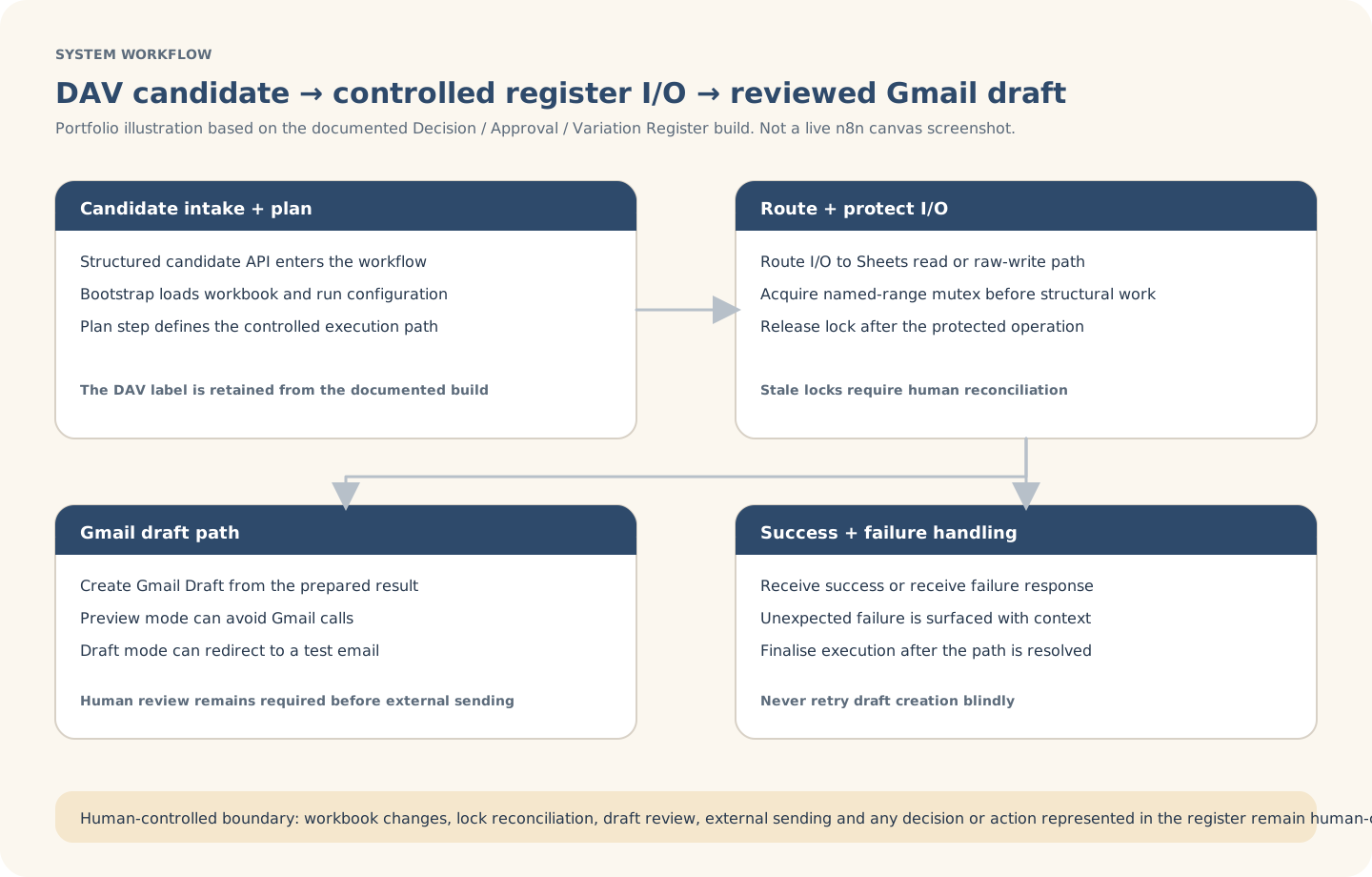
Explanatory workflow visual based on the documented portfolio build — not a live n8n canvas screenshot.
Inside the build
The build includes preview and test-draft modes so content can be inspected without immediately calling Gmail, plus an explicit rule that pending draft attempts require human reconciliation.
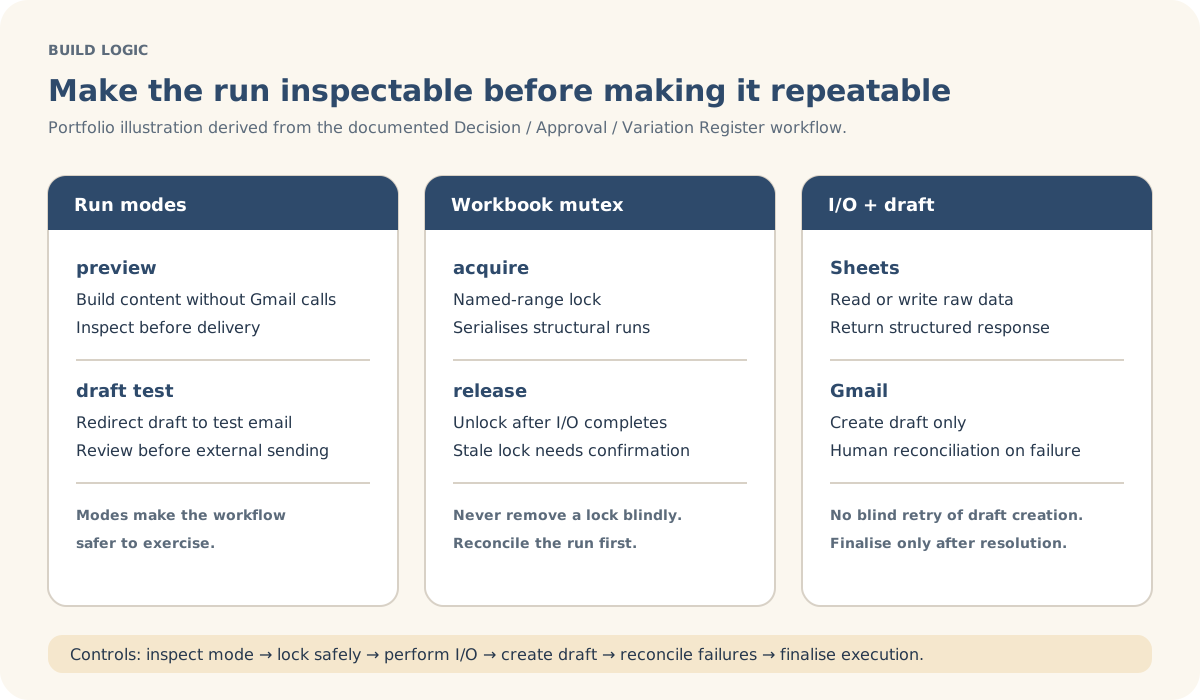
Explanatory build-detail visual derived from the documented workflow logic.
Actual build evidence
This is an authentic n8n canvas screenshot from the Decision / Approval / Variation Register build. It shows candidate intake, bootstrap, planning, routed Sheets operations, lock handling, Gmail draft creation and success/failure branches; the SVGs remain the clearer client-readable explanations.
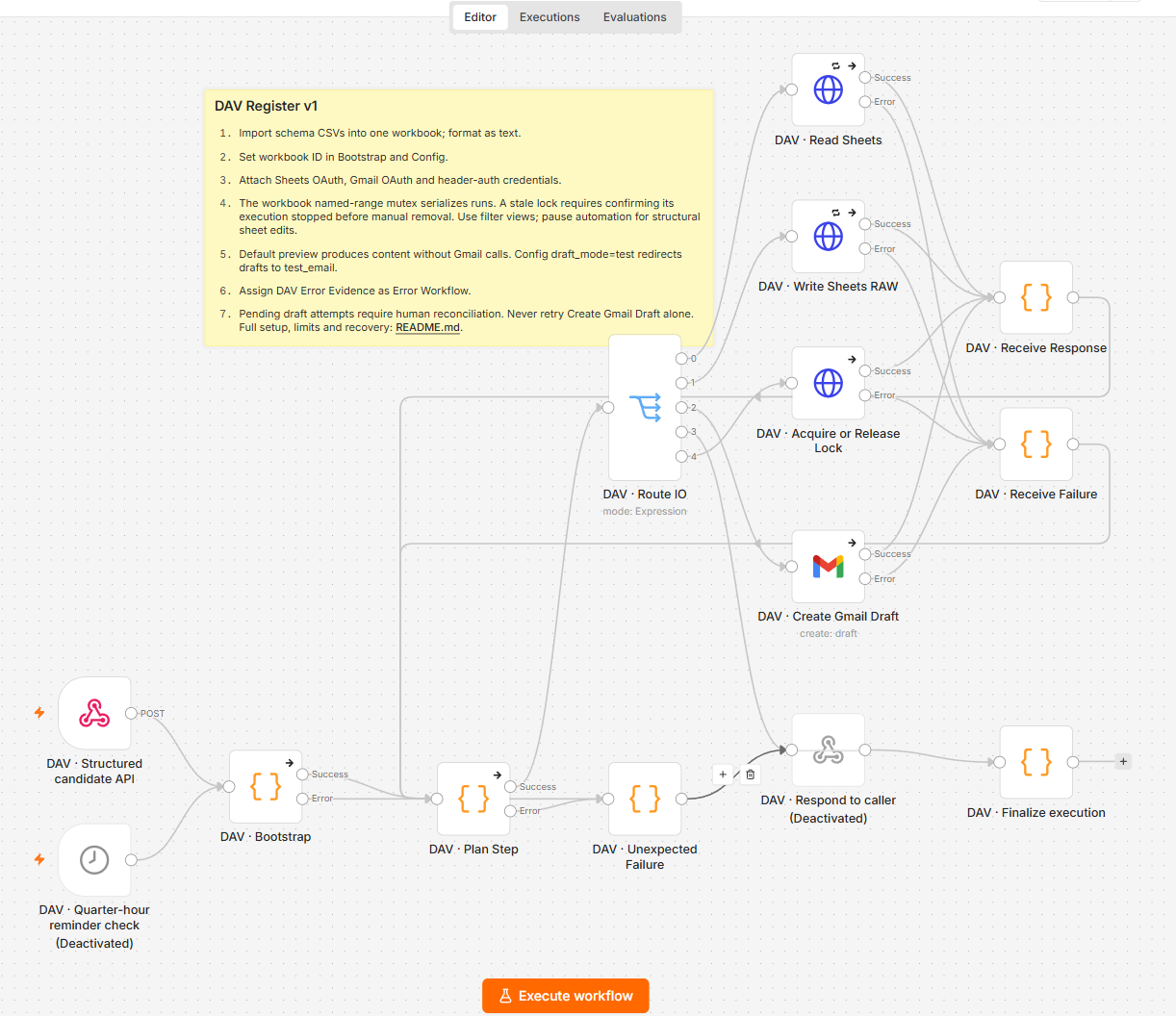
Actual n8n build screenshot supplied for this portfolio case study. The visible setup note contains configuration guidance only; no secret values are included. Click the image for an in-page larger view.
Controls & exceptions
The workflow can produce content without Gmail calls so the result can be inspected safely.
Draft mode can route to a test email rather than immediately targeting an external recipient.
A stale named-range lock requires confirming the prior execution has stopped before manual removal.
Pending draft attempts require human reconciliation; the Create Gmail Draft step is not retried in isolation.
What stays human-controlled
Automation supports register I/O, run protection, draft preparation and error surfacing. Human operators retain workbook structure decisions, lock reconciliation, draft review, external sending and any decision or action represented in the register.